Action Bias (Why do we prefer to do something rather than nothing?)
The Action Bias, a brief explanation
What is the Action Bias?
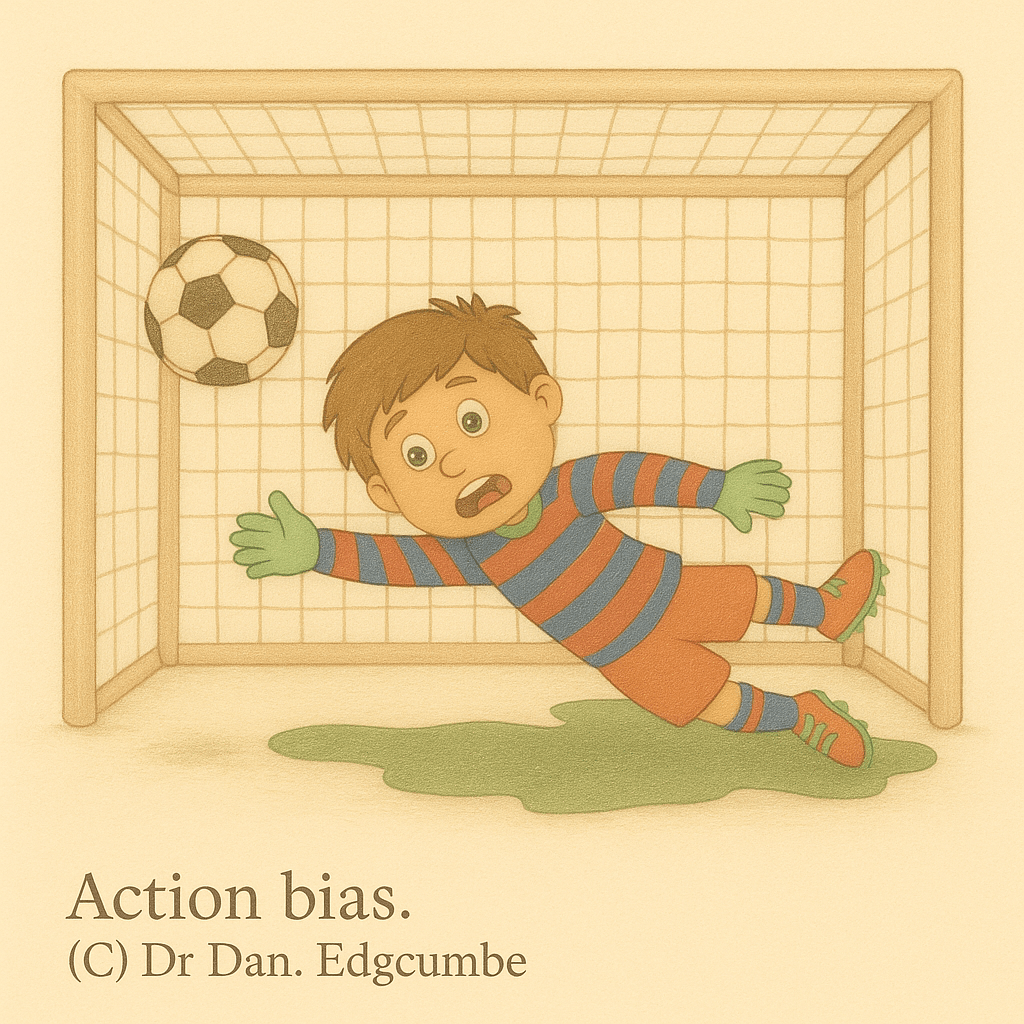
The action bias describes the tendency to favour action over inaction, even if there is no indication that acting would bring about a better result than inaction.
Examples
In politics when politicians do not take action on issues such as global warming but wishes that they appear to be doing so.
In sport when a football goalkeeper shows a preference for diving to either the left or right side in an attempt to block the ball, even when the ball hasn’t been kicked toward the goal yet.
In economics when there is an economic downfall central banks (e.g., Bank of England) favour action (e.g., increasing interest rates) over inaction, as they feel there will be public scrutiny if they do not act.
The literature
Bar-Eli. M., Azar, O. H., Ritov, L., Keidar-Levin, Y. & Schein, G. (2007). Action bias among elite soccer goalkeepers: the case of penalty kicks. Journal of Economic Psychology, 28(5), 606-621. Doi: 10.1016/j.joep.2006.12.001
Patt, A., Zeckhauser, R. (2000). Action bias and environmental decisions. Journal of Risk and Uncertainty, 21, 45-72. Doi: 10.1023/A:1026517309871
Thorpe, A., Sirota, M., Juanchich, M., & Orbell, S. (2020). Action bias in the public’s clinically inappropriate expectations for antibiotics. Journal of Experimental Psychology: Applied, 26(3), 422-431. Doi. 10.1037/xap0000269
 drdanedgcumbe.co.uk