Anchoring Bias (Why do we rely on the first piece of information that we receive?)
The Anchoring Effect, a brief explanation
What is the Anchoring Effect?
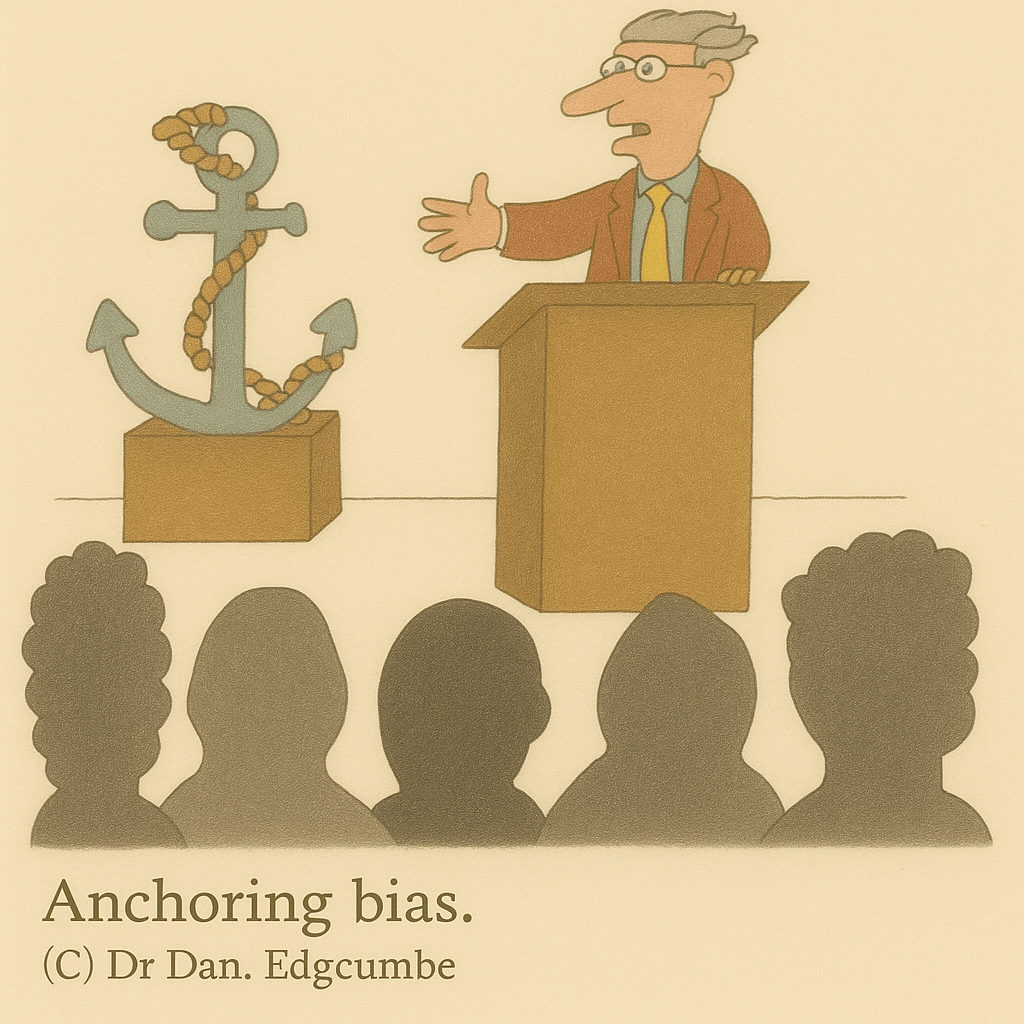
The anchoring effect describes the tendency for a decision to be influenced by an otherwise irrelevant piece of information (the anchor/reference point). This numeric anchor helps the user make a judgement about a value.
Examples
In negotiation the anchor is the starting point for the subsequent negotiations. As soon as one side states their first offer the (subjective) anchor is set. The counterbid is the made as a judgement that is informed by the anchor.
In a property auction any estimated value of a property that is presented in a text that accompanies the auction may act as an anchor. Subsequent bids for the property would then be made in accordance with the anchor in bidders who have read the text.
The literature
Beggs, A. & Graddy, K. (2009). Anchoring effects: evidence from art auctions. American Economic Review, 99(3), 1027-1039. Doi: 10.1257/aer.99.3.1027
Caputo, A. (2013). A literature review of cognitive biases in negation processes. International Journal of Conflict Management, 24(4), 374-398. Doi: 10.1108/IJCMA-08-2012-0064
 drdanedgcumbe.co.uk