Authority Bias (Why do we attribute grater accuracy to ‘authority’ figures?)
The Authority Bias, a brief explanation
What is the Authority Bias?
The authority bias describes the tendency to attribute greater accuracy and credibility to the opinion of figures in authority (even when they are providing an opinion on something outside of their expertise).
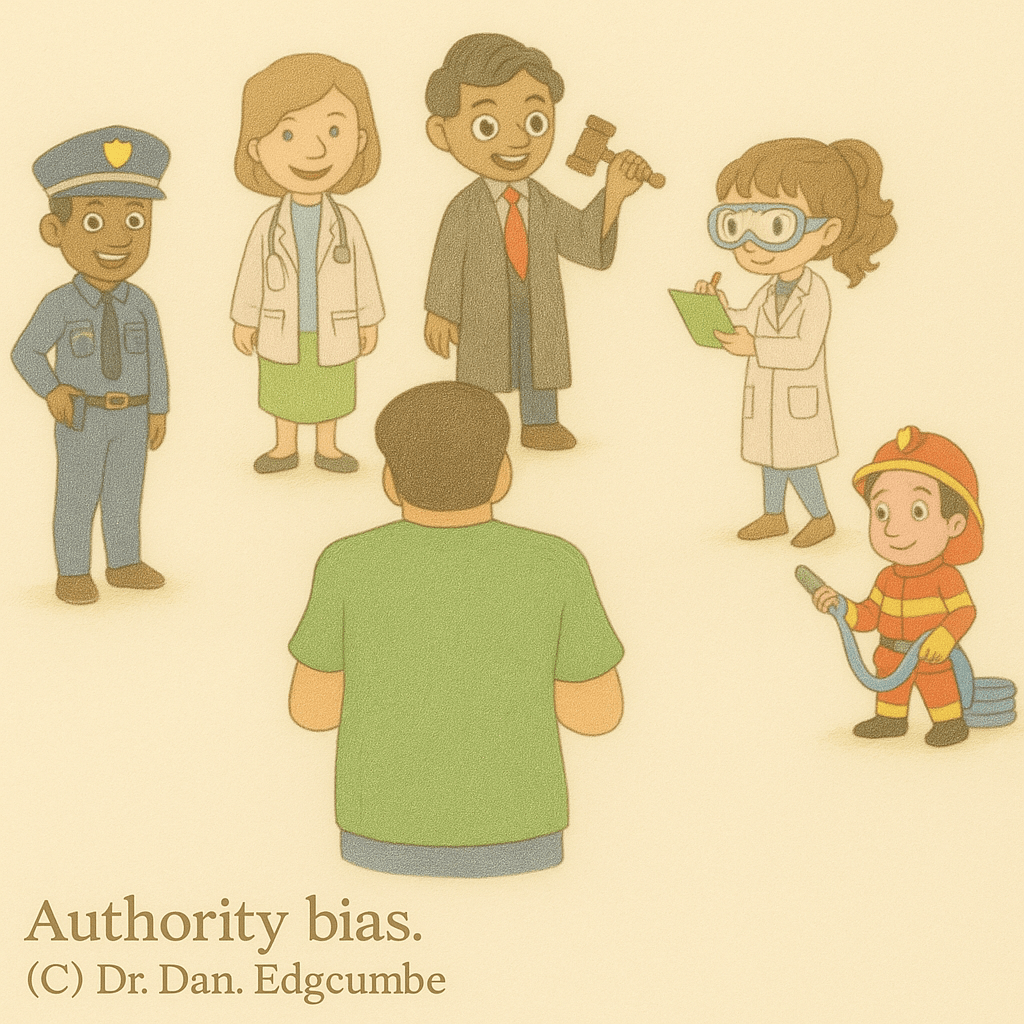
Examples
The majority of people accept the police as a legitimate authority with the right to apprehend those violating the law.
In advertising when a toothpaste company provides claims about their products they are often provided by a ‘dentist’ wearing a lab coat. The lab coat adds to the apparent trustworthiness of the speaker.
The literature
Jackson, J., Bradford, B., Hough, M., Myhill, A., Quinton, P. & Tyler, T. (2012). Why do people comply with the law? Legitimacy and the influence of legal institutions. British Journal of Criminology, 52(6), 1051-1071. Doi: 10.1093/bjc/azs032
Sharma, M., Jumar, M., Gonzalez, C. & Dutt, V. (2023). How the presence of cognitive biases in phishing emails affects human decision-making? Neural Information Processing, Doi: 10.1007/978-981-99-1642-9_47
 drdanedgcumbe.co.uk