Confirmation Bias (Why do we interpret ambiguous information to confirm our pre-existing beliefs?)
The Confirmation Bias, a brief explanation
What is the Confirmation Bias?
The confirmation bias is the tendency to search for, interpret, favour and recall information that confirms and supports our pre-existing beliefs whilst ignoring information that contradicts our beliefs.
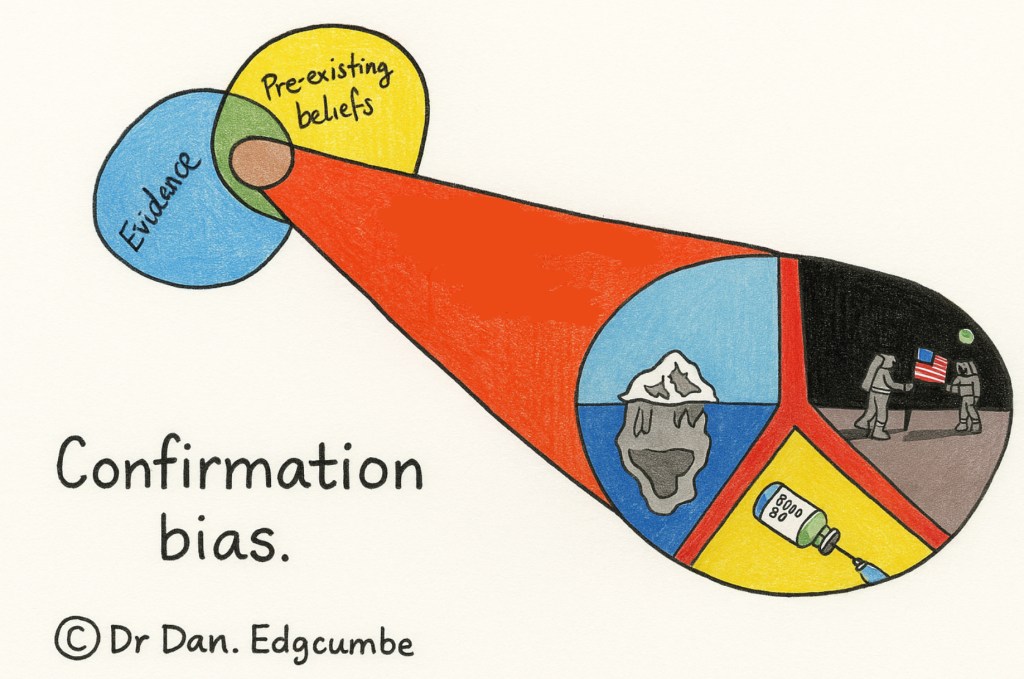
Examples
When working as a forensic scene of crime officer for a police force you find a partial match for a fingerprint at a crime scene. If you have some information about a possible suspect you may interpret this information to be a match to the suspect incorrectly.
Imagine that you believe that left-handed people are more creative than right-handed people. Whenever you encounter a person who is left-handed and creative you may place greater importance on meeting this person to confirm your belief whilst ignoring the right-handed creative people.
The literature
Hill, C., Memon, A. & McGeorge, P. (2010). The role of confirmation bias in suspect interviews: a systematic evaluation. Legal and Criminological Psychology, 13(2), 357-371. Doi: 10.1348/135532507X238682
Kassin, S. M., Dror, I. E. & Kukucka, J. (2013). The forensic confirmation bias: problems, perspectives, and proposed solutions. Journal of Applied Research in Memory and Cognition, 2(1), 42-54. Doi: 10.1016/j.jarmac.2013.01.001
 drdanedgcumbe.co.uk