Conjunction Fallacy (Why do we think that two things in conjunction are more probable than one thing by itself?)
The Conjunction Fallacy, a brief explanation
What is the Conjunction Fallacy?
The conjunction fallacy is the tendency to perceive that two things in conjunction are more probable than a single thing by itself.
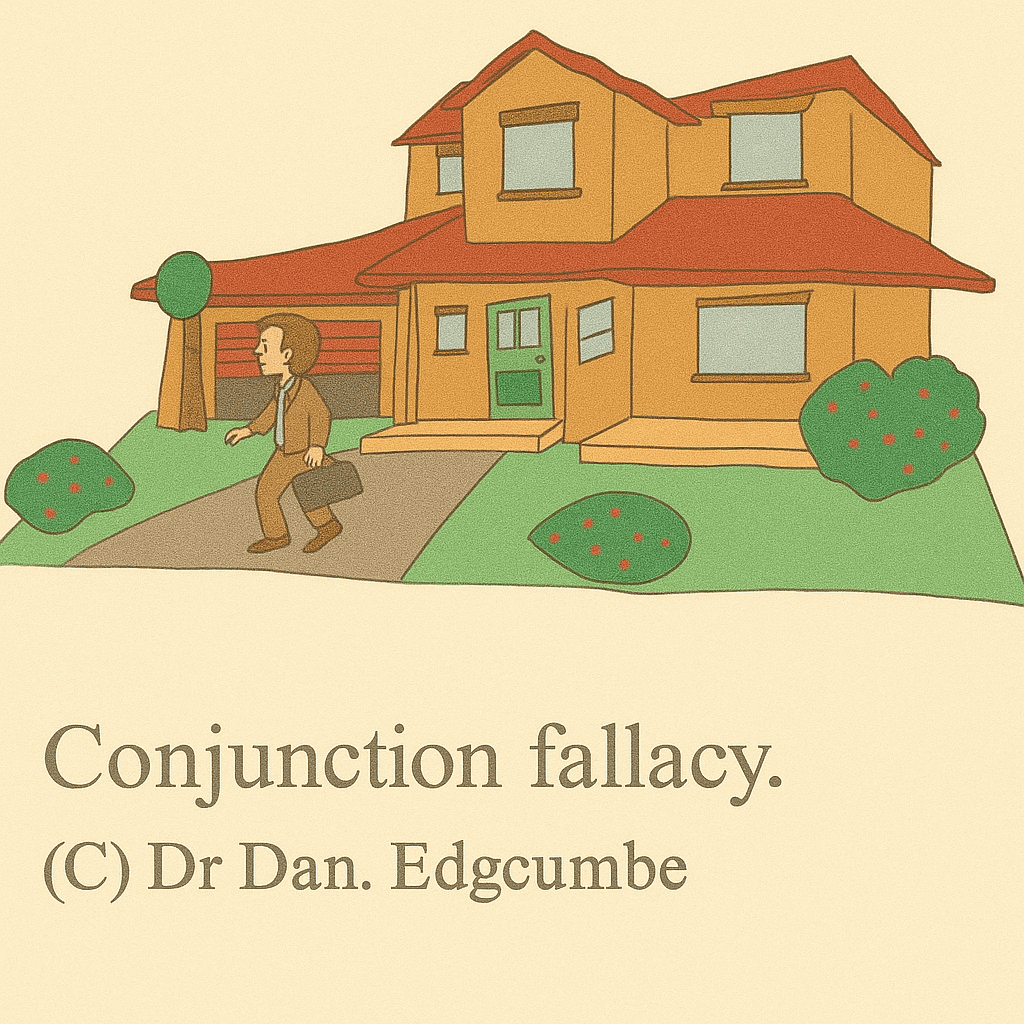
Examples
In a workplace a manager may think that is more likely that an employee wears glasses and is politically active rather than one of these alone.
When you see your neighbour leaving for work every morning wearing a suit and a tie you may mistakenly think that they work in a highly paid job if you have the perception that wearing a suit and tie and being wealthy are more probable than not.
The literature
Hertwig, R. & Gigerenzer, G. (1999). The ‘conjunction fallacy’ revisited: how intelligent inferences look like reasoning errors. Behavioral Decision Making, 12(4), 275-305. Doi: 10.1002/(SICI)1099-0771(199912)12:4<275::AID-BDM323>3.0.CO;2-M
Tversky, A., & Kahneman, D. (1983). Extensional versus intuitive reasoning: the conjunction fallacy in probability judgment. Psychological Review, 90(4), 293-315. Doi: 10.1037/0033-295X.90.4.293
 drdanedgcumbe.co.uk