Gambler’s Fallacy (Why do we believe that the outcome of past events influences future events?)
The Gambler’s Fallacy, a brief explanation
What is the Gambler’s Fallacy?
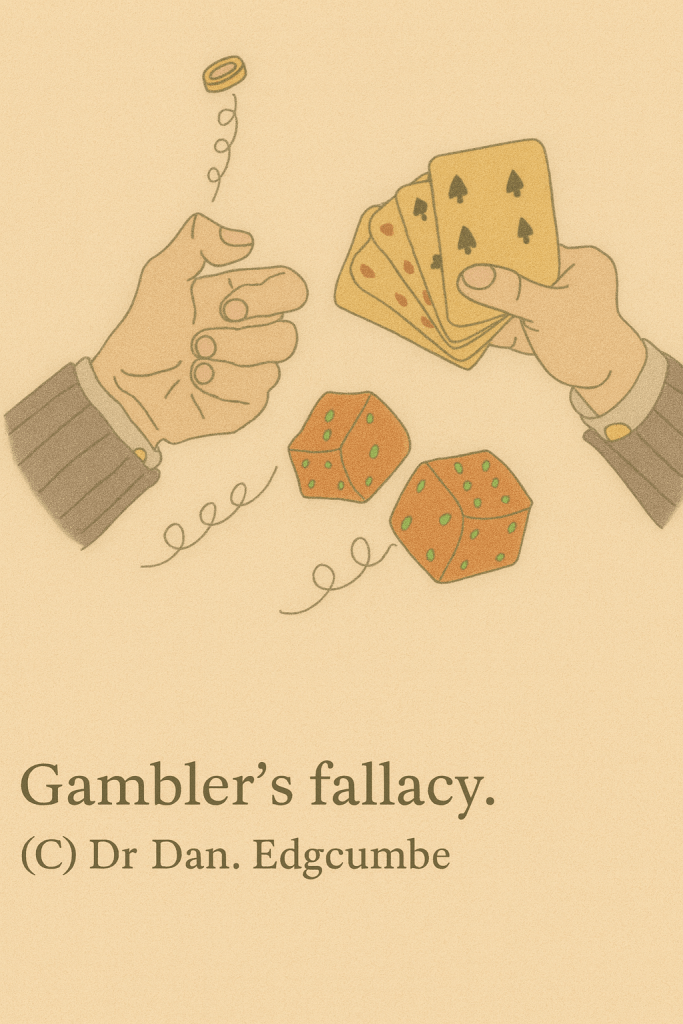
The Gambler’s fallacy is the belief that the frequency of past events (e.g., a coin landing heads up) influences the outcome of future events when an outcome seems ‘overdue’ (e.g., coin landing tails up).
Examples
Historically the sixteenth century king Henry the VIII wanted to have a son. After having several daughters he believed that a son was overdue and that his next child would therefore be a son.
When watching repeated coin flips and recording the outcomes you may see the coin land with heads up eight times in a row. Someone using the Gambler’s fallacy would expect a tail outcome soon.
The literature
Polin, B. A. & Benisaac, E. (2023). A longitudional analysis of the hot hand and gambler’s fallacy biases. Judgment and Decision Making, 18. Doi: 10.1017/jdm.2023.23
Shaw, C. A., Williams, R. J., Toria Violo, V., Williams, J. N., Demetrovics, Z. & Delfabbro, P. (2023). Cognitive factors that predict gambling fallacy endorsement. Journal of Gambling Studies, 39, 843-855. Doi: 10.1007/z10899-022-10177-9
 drdanedgcumbe.co.uk