Incongruent Base-rate Fallacy/Representativeness Heuristic (Why do we ignore base-rates in favour of descriptions?)
The Incongruent Base-rate Fallacy / Representativeness Heuristic, a brief explanation
What is the Incongruent Base-rate Fallacy?
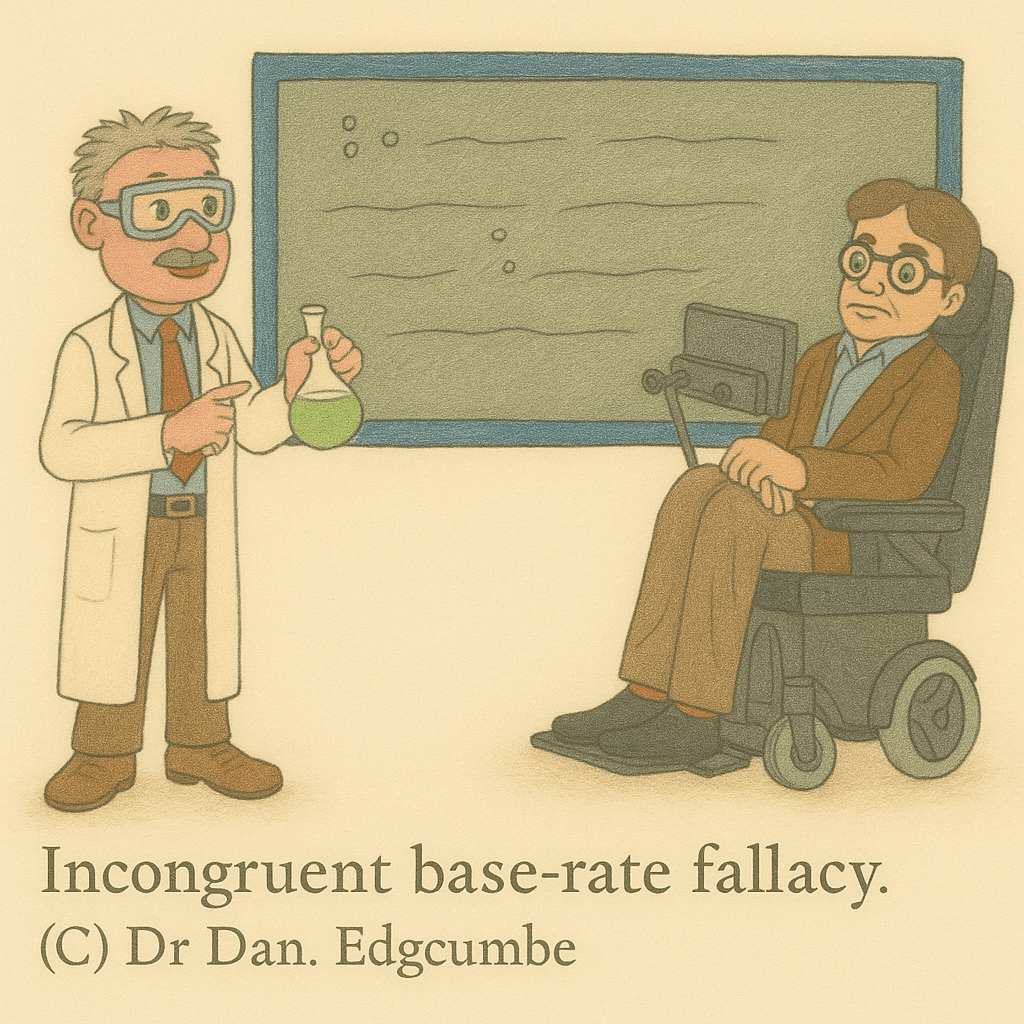
The incongruent base rate fallacy describes the tendency to ignore specific and detailed base-rates (e.g., statistics) in favour of descriptions and stereotypes when estimating likeliness.
Examples
In a job interview the interview panel (if using the heuristic) may ignore any statistics about a candidate and rely on what they believe the candidate is like by using a stereotype.
When seeing an old school friend at a reunion who you haven’t seen in years you may see a photo of them wearing a suit and tie and carrying a briefcase thus expect them to work in a professional job that requires a suit, tie and briefcase. The base-rate (number of students who go into a professional career from your school) could favour your old friend working in a different type of employment.
The literature
Fernández-Aguilar, C., Martín-Martín, J., Lorenzo, S. & Fernández Ajuria, A. (2021). Use of heuristics during the clinical decision process from family care physicians in real conditions. Journal of Evaluation in Clinical Practice, 28(1), 135-141. Doi: 10.1111/jep.13608
Whelehan, D., Conlon, K. & Ridgway, P. (2020). Medicine and heuristics: cognitive biases and medical decision-making. Irish Journal of Medical Science, 189, 1477-1484. Doi: 10.1007/s11845-020-02235-1
 drdanedgcumbe.co.uk