Just-world Hypothesis (Why do we believe that we all get what we deserve?)
The just-world hypothesis, a brief explanation
What is the Just-world hypothesis?
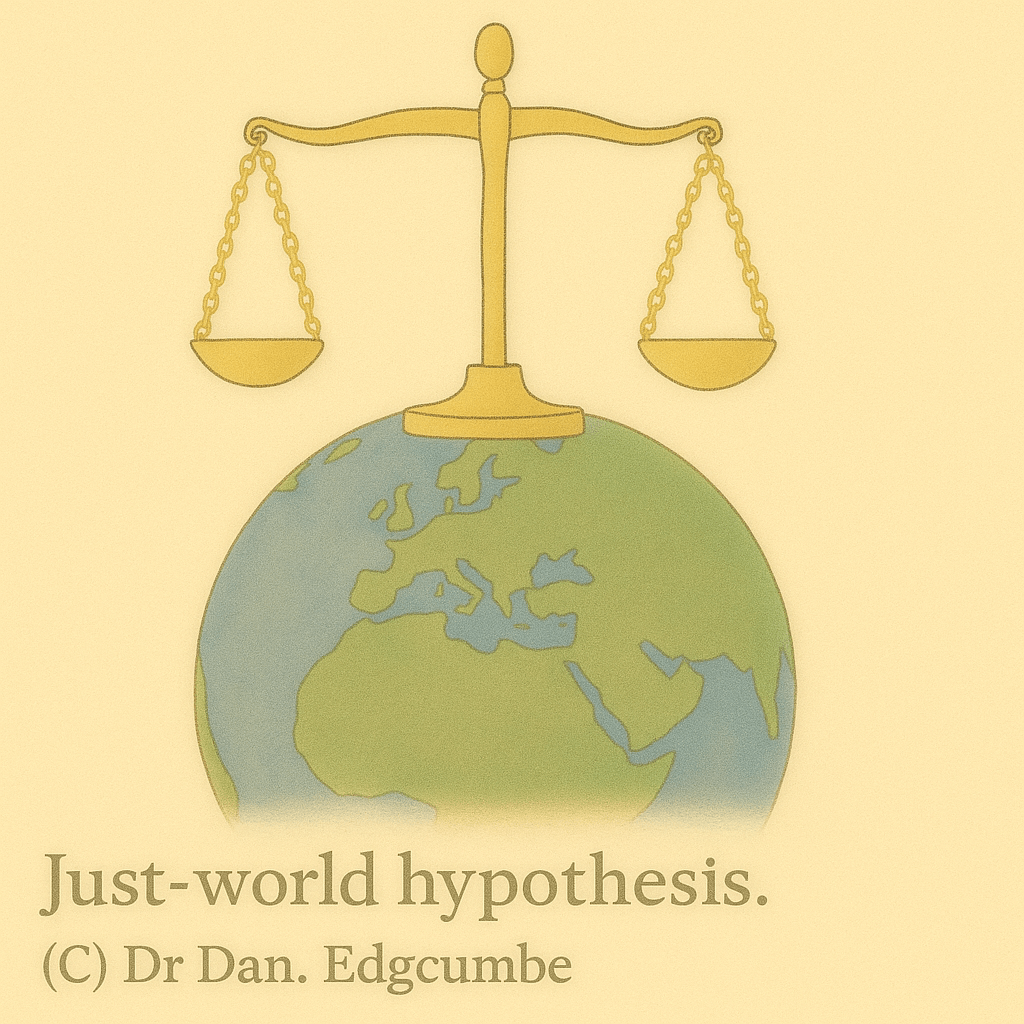
The just-world hypotheses is the tendency to believe that people who do good will have a good outcome of events. People who do bad will have bad outcomes.
Example
Imagine that a friend spends a lot of time volunteering for a charity and this provides some good opportunities for them. You may think that them doing good things caused good outcomes.
The literature
Goodman, S. & Carr, P. (2017). The just world hypothesis as an argumentative resource in debates about unemployment benefits. Journal of Community & Applied Social Psychology, 27(4), 312-313. Doi: 10.1002/casp.2314.
Roch, S. G., Zhuang, W., Park, J., Jin, F., & Brooks, R. R. (2023). Do just trainers matter? An investigation of felt obligation, affect, and endorsement of the just world hypothesis. Journal of Personnel Psychology, Doi: 10.1027/1866-5888/a000334
 drdanedgcumbe.co.uk