Less-is-better Effect (Why do we change our preferences when options are considered separately than together?)
The less-is-better effect, a brief explanation
What is the Less-is-better effect?
The less-is-better effect is the tendency to show a preference for a smaller or lesser alternative when it is evaluated separately from a large quantity of things.
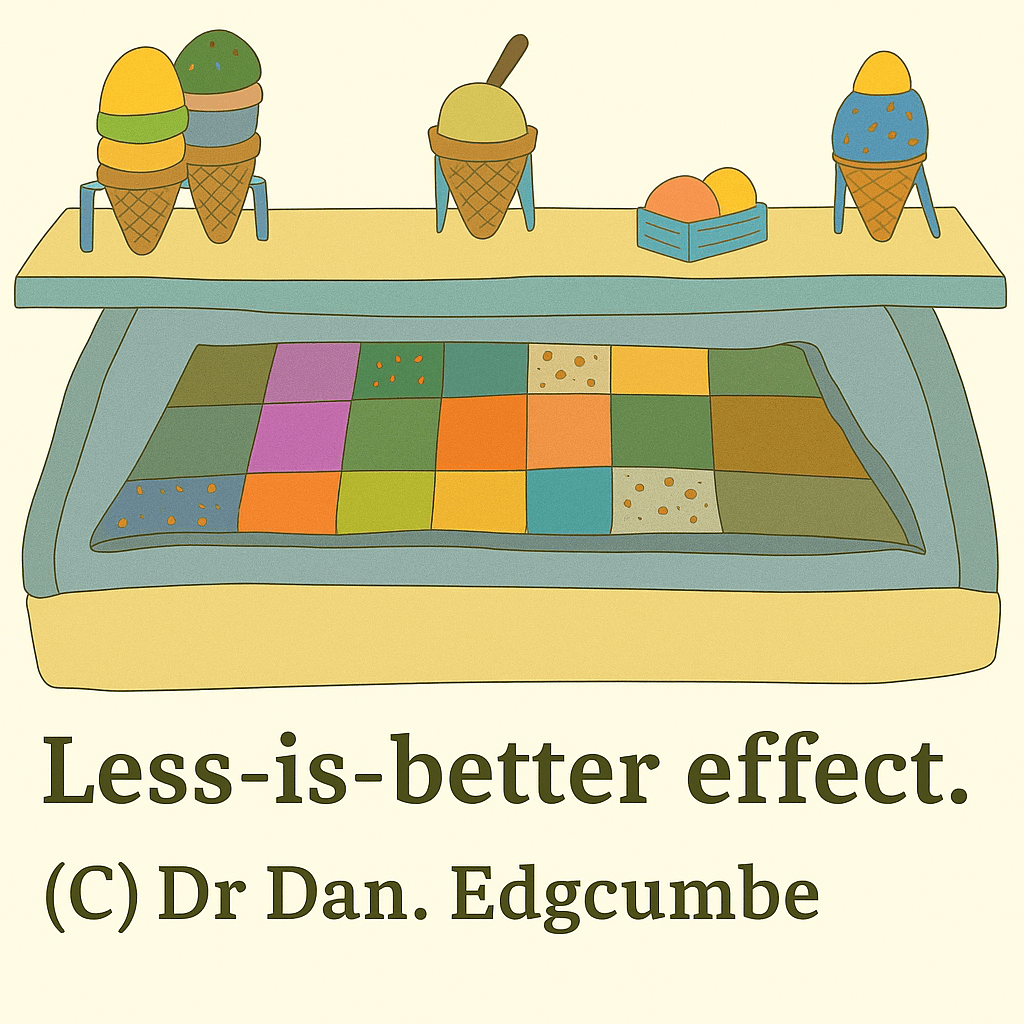
Example
When buying an ice cream at a beach you may be presented with a variety of options for example, 3-scope ice cream in a large cup or a 4-scope ice cream in a small cup. If you notice that differences in the ice-cream quantity you may opt for an ice cream with fewer scopes.
The literature
Hsee, C. K. (1998). Less is better: when low-value options are valued more highly than high-value options. Journal of Behavioral Decision Making, 11(2) 107-121. Doi: 10.1002/(SICI)1099-0771(199806)11;2<107::AID-BDM292>3.0.CO;2-Y
Parrish, A. E. & Sandgren, E. E. (2023). The less-is-better effect: a developmental perspective. Psychonomic Bulletin & Review. Doi: 10.3758/s13423-023-02318-x
 drdanedgcumbe.co.uk